
While it continues to review the contributions received as part of its public consultation on its informal guidance framework for sustainability initiatives, which closed on 31 July 2026, the French Competition Authority will hold an “Economy and Sustainability” workshop on 5 October focusing on environmental benefits. The event will bring together academics and practitioners specialising in environmental economics, industrial economics and competition law.
At the same time, the Authority is maintaining its “open door” policy and encourages companies to seek informal guidance on projects pursuing sustainability objectives, provided they have first conducted and documented their own self-assessment, which must be submitted to the Authority as part of their request.
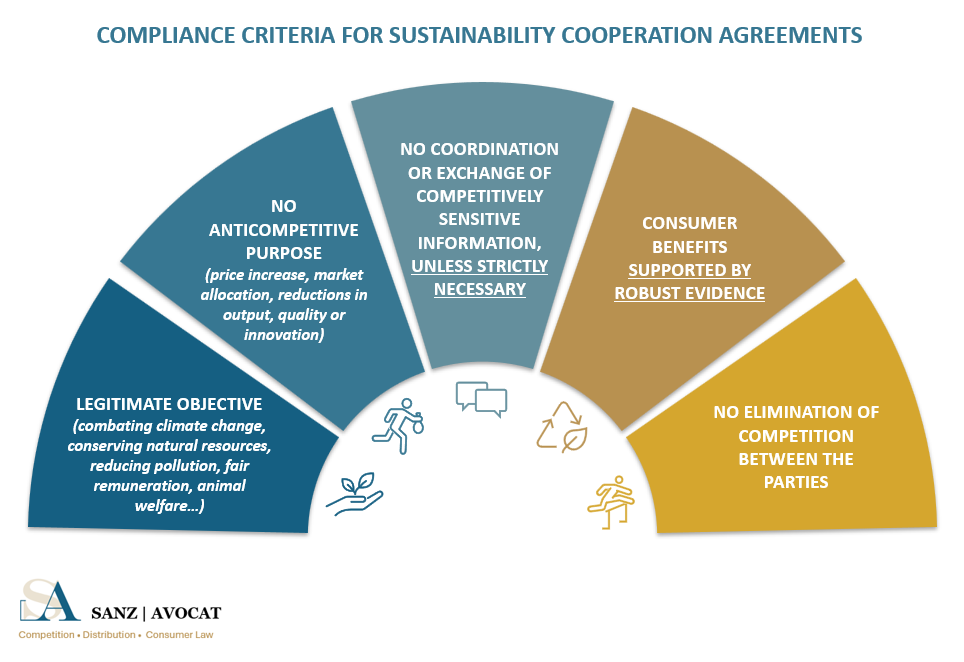
Compliance Criteria for Sustainability Cooperation Agreements
As a reminder, the compatibility of sustainability cooperation projects with competition law is subject to strict conditions:
- the objectives pursued must be legitimate, such as combating climate change, preserving natural resources, reducing pollution, ensuring a fair income, or promoting animal welfare;
- the cooperation must not include any anticompetitive purpose, such as coordination on price increases, market sharing, or reductions in output, quality or innovation;
- the cooperation must not involve coordination or exchanges of competitively sensitive information on competition parameters, including sustainability-related competitive strategies (such as production, marketing or communication choices), unless it can be demonstrated that such exchanges are indispensable to achieving the project’s legitimate objectives;
- the cooperation must generate benefits for consumers, including, for example, environmental benefits; and
- the cooperation must not eliminate competition between the parties on the relevant market.
Safe Harbour for Sustainability Standardisation Agreements
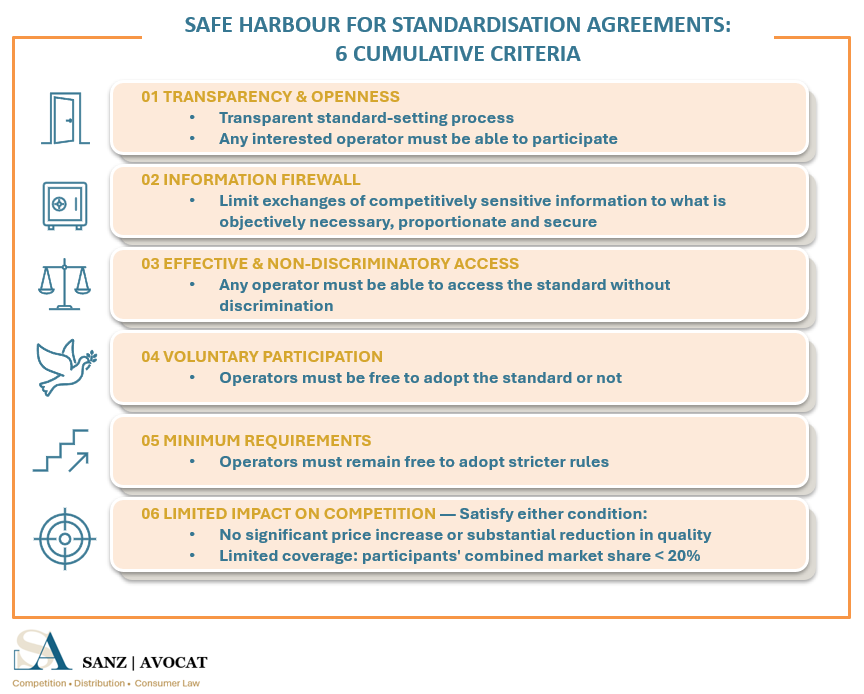
Where a project involves the adoption of sustainability standards, companies should seek to comply with the criteria established by the European Commission in order to benefit from the informal “safe harbour” set out in the Horizontal Cooperation Guidelines (Section 9.3.2):
- transparency and openness: establish a transparent standard-setting process allowing any interested operator to participate at every stage of its development;
- information safeguards: limit exchanges of commercially sensitive information and ensure that any such exchanges are objectively necessary, proportionate and appropriately protected;
- effective and non-discriminatory access: ensure that all operators can effectively access the standard on non-discriminatory terms;
- voluntary participation: operators must not be required to comply with the standard if they do not wish to join it;
- minimum requirements only: while participants may be required to comply with binding rules in order to adhere to the standard, they must remain free to adopt more stringent sustainability measures; and
- limited impact on competition: satisfy one of the two alternative conditions identified by the European Commission:
- no appreciable increase in prices and no significant reduction in quality; or
- limited market coverage (combined market share of participating companies below 20%).
Demonstrating Environmental Benefits
As part of both self-assessments and requests for informal guidance, it is important to properly document the expected benefits of the proposed cooperation through robust evidence and to weigh those benefits against any potential adverse effects on prices, consumer choice or other competitive parameters.
The methodologies used to quantify environmental benefits and harms, and to incorporate them into competition law assessments, will be one of the key topics discussed during the workshop on 5 October 2026.
Published on 30.08.2026.