SANZ | AVOCAT

Author: Arnaud Sanz

  • Merger control: new notification thresholds applicable in France

    Merger control: new notification thresholds applicable in France

    Which Thresholds?

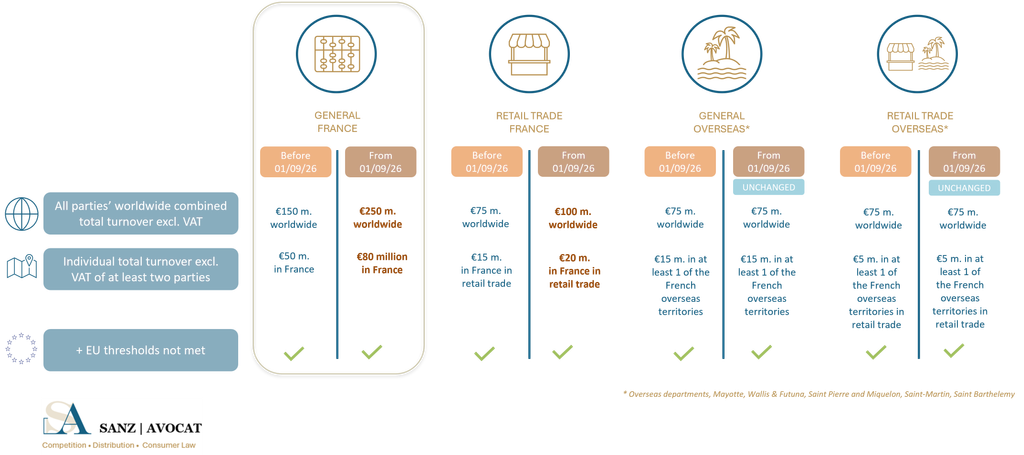
    As from 1 September 2026, new merger control thresholds will apply (Law No. 2026-403, 26 May 2026):

    • if EU thresholds are not met, transactions must be notified to the French Competition Authority where the parties (acquirer(s), other controlling shareholders and target) have a combined worldwide consolidated turnover exceeding €250 million (excluding taxes), and at least two of those parties each generate consolidated turnover in France exceeding €80 million (excluding taxes);
    • the specific thresholds in the retail sector are increased: the parties’ combined worldwide consolidated turnover must exceed €100 million (excluding taxes), and at least two of those parties each generate consolidated turnover in retail exceeding €20 million (excluding taxes).

    The thresholds in the overseas territories remain unchanged:

    • Outside retail trade: the aggregate worldwide turnover of the parties must exceed €75 million (excluding taxes), and at least two of the parties each generate turnover in the French overseas territories of more than €15 million (excluding taxes);
    • For retail trade: the aggregate worldwide turnover of the parties exceeds €75 million (excluding taxes), and at least two of the parties each generate retail turnover in the French overseas territories of more than €5 million (excluding taxes.
    Managing the New Thresholds Depending on the Transaction Timeline

    The new thresholds apply only to transactions filed as from 1 September 2026, i.e. those whose closing occurs after this date (see French competition authority’s FAQ).

    Any failure to notify a transaction completed prior to 1 September 2026 may expose the parties to gun-jumping penalties where the former notification thresholds were triggered.

    Where a transaction has already been pre-notified or notified before that date under the former thresholds, the review process will continue until the Authority issues its decision. However, if the parties do not meet the new thresholds, the pre-notification or notification may still be withdrawn, provided that the transaction has not been implemented prematurely before 1 September, even where the Authority had authorised its implementation by granting a derogation from the standstill obligation.

    Published on 30.08.2026.

  • Merger Control: Below the Thresholds, but Soon Within Reach in France?

    Merger Control: Below the Thresholds, but Soon Within Reach in France?

    Despite the recent increase in French merger control notification thresholds, discussions continue regarding the possible introduction of a mechanism allowing the review of transactions that fall below those thresholds.

    What is the objective?

    As highlighted in its 2025 Annual Report, published in July 2026, the French Competition Authority continues to advocate the introduction of a call-in power enabling it to review certain transactions that are not subject to mandatory notification.

    The aim is to prevent acquisitions involving businesses that currently generate little turnover but have significant competitive potential from escaping merger control scrutiny, particularly in the digital, healthcare and biotechnology sectors.

    What would be the criteria?

    Following the public consultation conducted in 2025, the Authority has expressed a preference for a targeted and proportionate mechanism based on several cumulative criteria:

    • an identifiable turnover threshold;
    • a sufficient nexus with France;
    • the existence of a competition concern; and
    • short intervention deadlines.

    What legal basis would be required?

    The introduction of such a mechanism would require an amendment to the French Commercial Code. The Authority has already indicated that, should such reform be enacted, it would publish guidelines setting out the conditions for the exercise of its call-in power in order to enhance legal certainty and predictability for businesses.

    What would be the implications for M&A transactions?

    If adopted, the mere fact that an acquisition falls below the notification thresholds would no longer be sufficient to rule out the risk of prior regulatory review in France.

    For transactions likely to have a significant impact on competition, particularly the acquisition of an innovative, emerging or rapidly growing company by an already powerful market player, the possibility of a call-in review would need to be factored into the transaction timetable from the very outset of the merger control assessment.

    That said, France would not be acting in isolation. Similar risks already exist internationally: ten Member States of the European Economic Area have mechanisms allowing the review of certain concentrations falling below the ordinary notification thresholds (Denmark, Hungary, Ireland, Italy, Iceland, Latvia, Lithuania, Norway, Slovenia and Sweden), while several other jurisdictions are also considering adopting comparable regimes.

    Published on 30.08.2026.

  • Active Scrutiny of Killer Acquisitions?

    Active Scrutiny of Killer Acquisitions?

    “Predatory” acquisitions that fall outside the scope of merger control remain exposed to ex post scrutiny under the rules on abuse of a dominant position.

    A reminder: The Doctolib Case

    The French Competition Authority adopted this approach on below-threshold transactions for the first time in the Doctolib case (Decision No. 25-D-06 of 6 November 2025).

    In that case, Doctolib acquired its competitor MonDocteur without notifying the transaction under merger control rules, as the applicable turnover thresholds were not met.

    Nevertheless, the Authority considered the transaction to be a predatory acquisition through which Doctolib, holding a dominant position, sought to eliminate its main competitor and lock up the online medical appointment booking market.

    As a result, the Authority found that Doctolib had abused its dominant position on this basis alone. The fine imposed for this infringement remained largely symbolic (€50,000) to take into account the lack of prior French precedent.

    European Precedents

    The decision follows the reasoning adopted by the Court of Justice of the European Union in its Towercast judgment of 16 March 2023 (Case C-449/21), which confirmed that a concentration falling below merger control thresholds may, after completion, be examined under Article 102 TFEU where it is capable of constituting an abuse of a dominant position and substantially impeding competition.

    In reality, this approach is not new. It can be traced back to the Court’s Continental Can judgment of 21 February 1973 (Case 6/72).

    What Comes Next?

    The Doctolib decision is not yet final and is currently under review by the Paris Court of Appeal. Given the Court’s caseload, however, a judgment is unlikely before 2027.

    In the meantime, dominant companies should exercise particular caution when contemplating the acquisition of a competitor, especially where the transaction could be perceived as aiming to remove that competitor from the market.

    Internal documents and preparatory exchanges concerning the objectives of the transaction should be reviewed with particular care.

    Depending on the circumstances, a proactive engagement with the Competition Authority may also be advisable.

    Published on 30.08.2026.

  • Sustainability Cooperation: Assessing and Taking Environmental Benefits into Account

    Sustainability Cooperation: Assessing and Taking Environmental Benefits into Account

    While it continues to review the contributions received as part of its public consultation on its informal guidance framework for sustainability initiatives, which closed on 31 July 2026, the French Competition Authority will hold an “Economy and Sustainability” workshop on 5 October focusing on environmental benefits. The event will bring together academics and practitioners specialising in environmental economics, industrial economics and competition law.

    At the same time, the Authority is maintaining its “open door” policy and encourages companies to seek informal guidance on projects pursuing sustainability objectives, provided they have first conducted and documented their own self-assessment, which must be submitted to the Authority as part of their request.

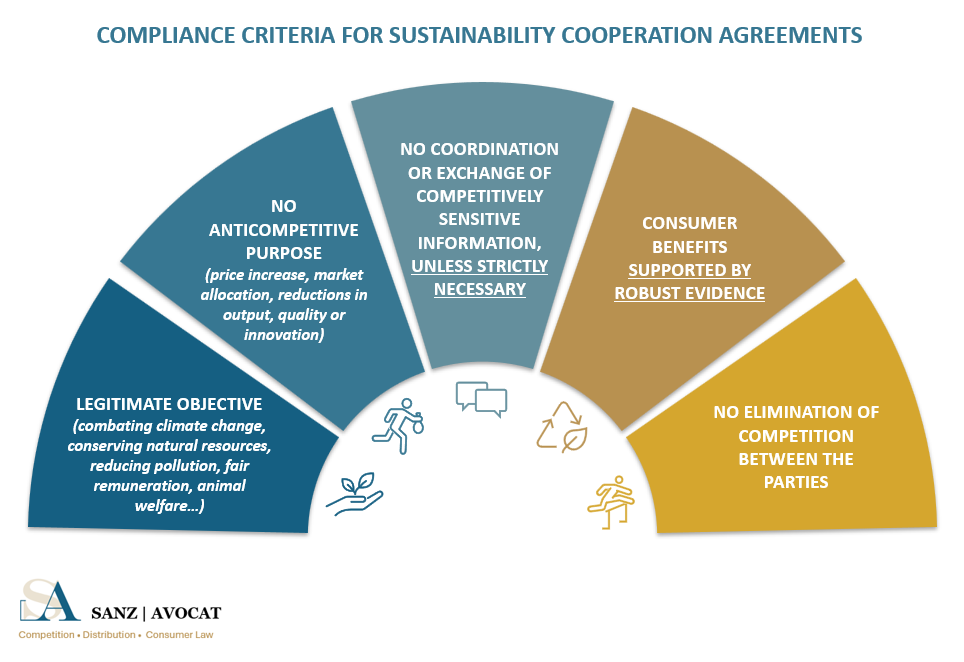
    Compliance Criteria for Sustainability Cooperation Agreements

    As a reminder, the compatibility of sustainability cooperation projects with competition law is subject to strict conditions:

    • the objectives pursued must be legitimate, such as combating climate change, preserving natural resources, reducing pollution, ensuring a fair income, or promoting animal welfare;
    • the cooperation must not include any anticompetitive purpose, such as coordination on price increases, market sharing, or reductions in output, quality or innovation;
    • the cooperation must not involve coordination or exchanges of competitively sensitive information on competition parameters, including sustainability-related competitive strategies (such as production, marketing or communication choices), unless it can be demonstrated that such exchanges are indispensable to achieving the project’s legitimate objectives;
    • the cooperation must generate benefits for consumers, including, for example, environmental benefits; and
    • the cooperation must not eliminate competition between the parties on the relevant market.

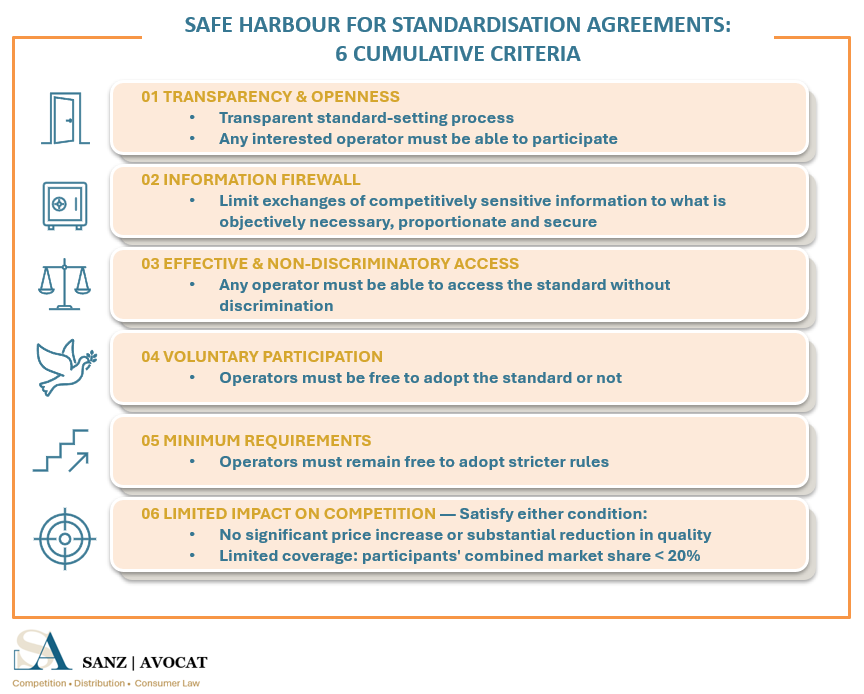
    Safe Harbour for Sustainability Standardisation Agreements

    Where a project involves the adoption of sustainability standards, companies should seek to comply with the criteria established by the European Commission in order to benefit from the informal “safe harbour” set out in the Horizontal Cooperation Guidelines (Section 9.3.2):

    • transparency and openness: establish a transparent standard-setting process allowing any interested operator to participate at every stage of its development;
    • information safeguards: limit exchanges of commercially sensitive information and ensure that any such exchanges are objectively necessary, proportionate and appropriately protected;
    • effective and non-discriminatory access: ensure that all operators can effectively access the standard on non-discriminatory terms;
    • voluntary participation: operators must not be required to comply with the standard if they do not wish to join it;
    • minimum requirements only: while participants may be required to comply with binding rules in order to adhere to the standard, they must remain free to adopt more stringent sustainability measures; and
    • limited impact on competition: satisfy one of the two alternative conditions identified by the European Commission:
      • no appreciable increase in prices and no significant reduction in quality; or
      • limited market coverage (combined market share of participating companies below 20%).

    Demonstrating Environmental Benefits

    As part of both self-assessments and requests for informal guidance, it is important to properly document the expected benefits of the proposed cooperation through robust evidence and to weigh those benefits against any potential adverse effects on prices, consumer choice or other competitive parameters.

    The methodologies used to quantify environmental benefits and harms, and to incorporate them into competition law assessments, will be one of the key topics discussed during the workshop on 5 October 2026.

    Published on 30.08.2026.

  • Business negotiations: a tighter timeline for certain supply agreements

    Business negotiations: a tighter timeline for certain supply agreements

    The French Agricultural Emergency Act of 18 August 2026, which entered into force on 20 August, has significantly brought forward this year’s negotiation timetable for certain suppliers (Article 54 of Act No. 2026-796 of 18 August 2026 on the Protection and Sovereignty of Agriculture).

    Two Deadlines for Annual Supply Agreements

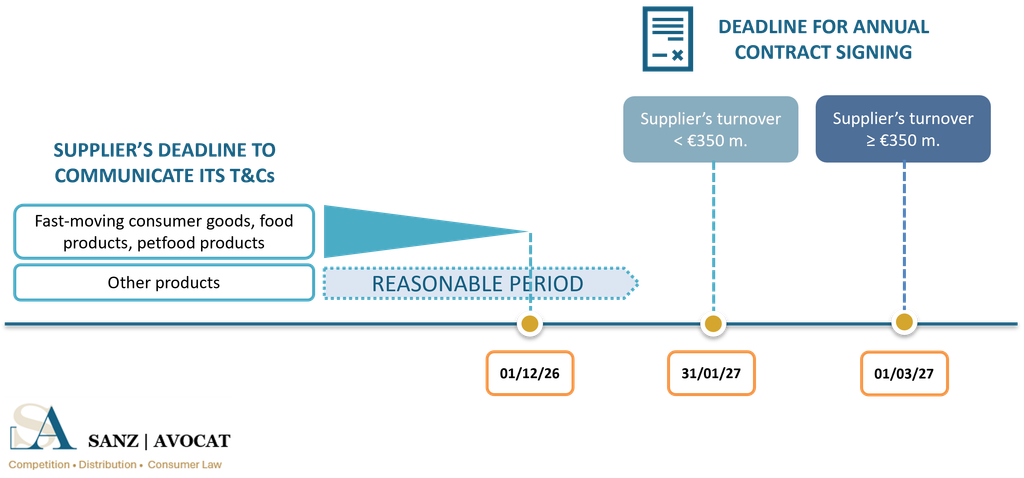
    Depending on the supplier’s worldwide turnover excluding VAT (consolidated or combined, based on the most recent completed financial year), two distinct timetables now apply to the annual supply agreement (or framework agreement supplemented by implementing agreements).

    Regardless of the products concerned, the agreement must be signed by:

    • 31 January 2027 where the supplier’s group turnover is below €350 million;
    • 1 March 2027 where the supplier’s group turnover is €350 million or more.

    Unchanged Timetable for the Communication of General Terms and Conditions of Sale (GTCS)

    Where the products include fast-moving consumer goods (FMCGs), food products or pet food products, suppliers must continue to provide their General Terms and Conditions of Sale (GTCS) no later than 1 December 2026, regardless of their turnover.

    For all other products, the GTCS must still be communicated within a reasonable timeframe to allow compliance with the applicable deadline for signing the agreement.

    Published on 30.08.2026.

  • Price negotiations: optimizing existing levers and leveraging the agricultural emergency law

    Price negotiations: optimizing existing levers and leveraging the agricultural emergency law

    As the next round of annual pricing negotiations approaches, suppliers should revisit the legal tools available to protect their pricing policies and strengthen their contractual position.

    France’s Agricultural Emergency Act of 18 August 2026 (Law No. 2026-796 of 18 August 2026 on emergency measures for the protection of agriculture and agricultural sovereignty), entered into force on 20 August, introduces several new mechanisms that may provide additional leverage in negotiations with retailers.

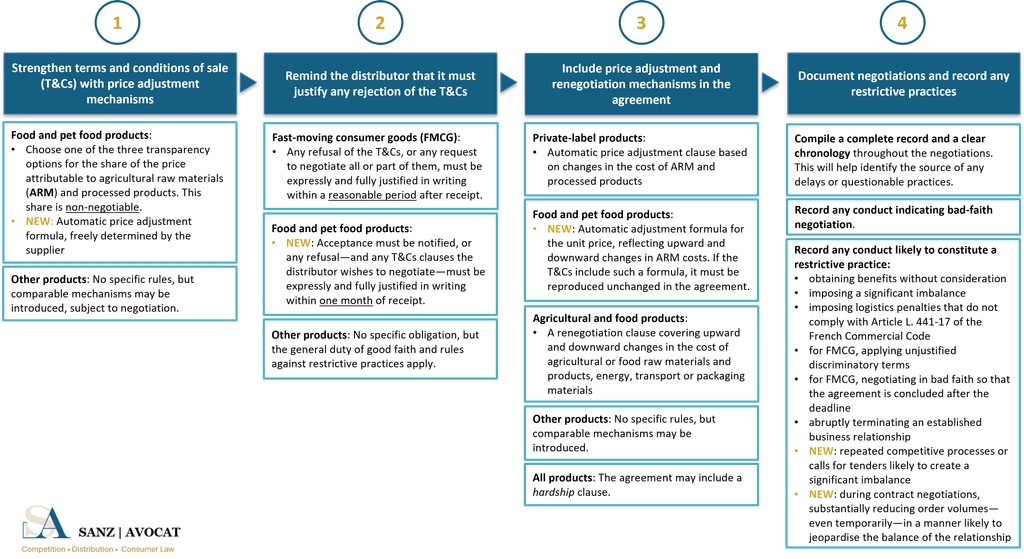
    This briefing provides an operational summary in 4 steps and a full analysis exploring a number of practical measures suppliers may consider in order to:

    • strengthen their general terms and conditions through price revision mechanisms;
    • remind retailers of their obligations when rejecting or seeking to negotiate suppliers’ terms;
    • enhance commercial agreements through appropriately drafted price revision and renegotiation clauses; and
    • effectively document negotiations and identify potentially unfair trading practices, particularly the two new practices introduced by the Agricultural Emergeny Act (which apply across all sectors) in the event of repeated tender procedures and subtantial reductions in order volumes.

    Particular attention should be given to the mechanisms introduced or reinforced by the Agricultural Emergency Act. Although these mechanisms mainly apply to food products and pet food, suppliers of other product categories may also find them a useful source of inspiration.

    Read the full analysis.

    Published on 01.09.2026.