SANZ | AVOCAT

Category: Business relationship

  • Business negotiations: a tighter timeline for certain supply agreements

    Business negotiations: a tighter timeline for certain supply agreements

    The French Agricultural Emergency Act of 18 August 2026, which entered into force on 20 August, has significantly brought forward this year’s negotiation timetable for certain suppliers (Article 54 of Act No. 2026-796 of 18 August 2026 on the Protection and Sovereignty of Agriculture).

    Two Deadlines for Annual Supply Agreements

    Depending on the supplier’s worldwide turnover excluding VAT (consolidated or combined, based on the most recent completed financial year), two distinct timetables now apply to the annual supply agreement (or framework agreement supplemented by implementing agreements).

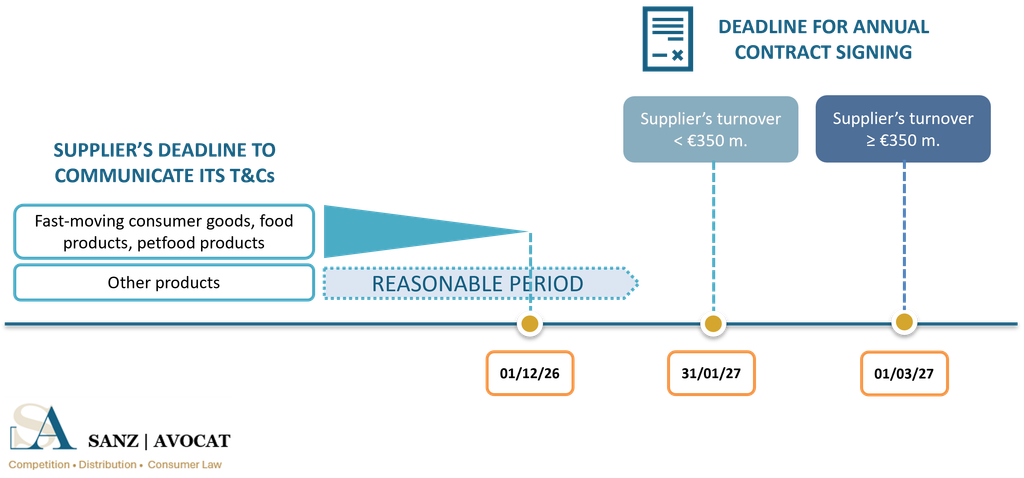
    Regardless of the products concerned, the agreement must be signed by:

    • 31 January 2027 where the supplier’s group turnover is below €350 million;
    • 1 March 2027 where the supplier’s group turnover is €350 million or more.

    Unchanged Timetable for the Communication of General Terms and Conditions of Sale (GTCS)

    Where the products include fast-moving consumer goods (FMCGs), food products or pet food products, suppliers must continue to provide their General Terms and Conditions of Sale (GTCS) no later than 1 December 2026, regardless of their turnover.

    For all other products, the GTCS must still be communicated within a reasonable timeframe to allow compliance with the applicable deadline for signing the agreement.
    Published on 30.08.2026.

  • Price negotiations: optimizing existing levers and leveraging the agricultural emergency law

    Price negotiations: optimizing existing levers and leveraging the agricultural emergency law

    As the next round of annual pricing negotiations approaches, suppliers should revisit the legal tools available to protect their pricing policies and strengthen their contractual position.

    France’s Agricultural Emergency Act of 18 August 2026 (Law No. 2026-796 of 18 August 2026 on emergency measures for the protection of agriculture and agricultural sovereignty), entered into force on 20 August, introduces several new mechanisms that may provide additional leverage in negotiations with retailers.

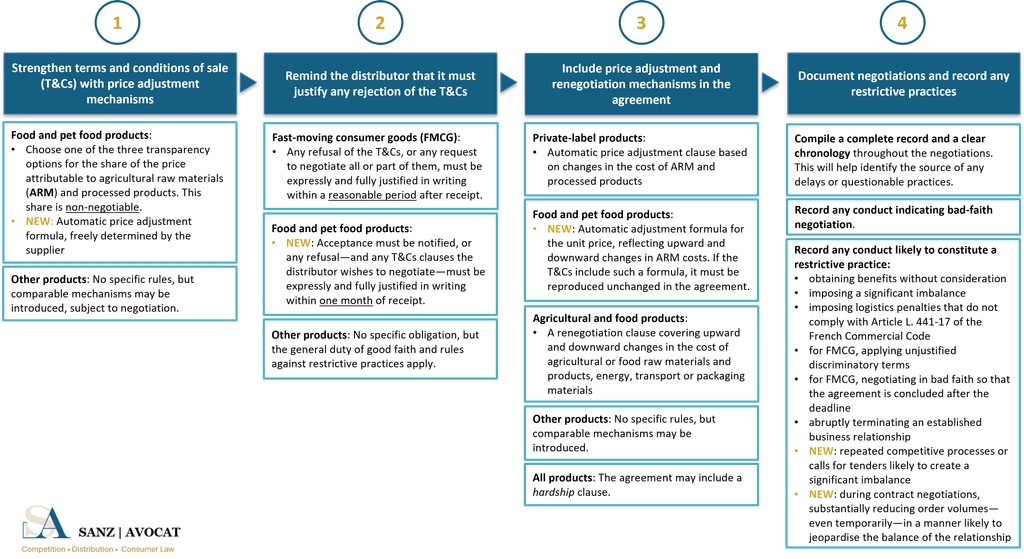
    This briefing provides an operational summary in 4 steps and a full analysis exploring a number of practical measures suppliers may consider in order to:

    • strengthen their general terms and conditions through price revision mechanisms;
    • remind retailers of their obligations when rejecting or seeking to negotiate suppliers’ terms;
    • enhance commercial agreements through appropriately drafted price revision and renegotiation clauses; and
    • effectively document negotiations and identify potentially unfair trading practices, particularly the two new practices introduced by the Agricultural Emergeny Act (which apply across all sectors) in the event of repeated tender procedures and subtantial reductions in order volumes.

    Particular attention should be given to the mechanisms introduced or reinforced by the Agricultural Emergency Act. Although these mechanisms mainly apply to food products and pet food, suppliers of other product categories may also find them a useful source of inspiration.

    Read the full analysis.

    Published on 01.09.2026.